Ruminations as we develop and manage a small farm in southeast Iowa. Click photos for larger images. Click here for farm map.
Showing posts with label creek. Show all posts

Monday, June 24, 2013

In the Merry Wet Month of May

In high contrast to last year's drought and heat wave, which was well underway in May, this spring has been long, cool, and wet. Perhaps at least partially due to the different weather, we notice many other differences in how the plant and animal populations are expressed. The later onset of warmer temperatures meant that I saw lots of flowering plants and trees that last year I missed by not arriving here on the farm until mid-April.

Whether through the action of squirrels or the whimsy of previous residents, there are patches of tame flowers in unexpected places away from the farmstead, for instance the bearded iris near Eye Chair, the day lilies along the dam and in the road ditch, and these daffodils on the far side of the pond.


This crabapple was festooned with blossoms, though a bit past its prime and beginning to leaf out by the time I made this photograph.


I'm not a skilled botanical taxonomist and so can only say that these looked up close like tiny bleeding heart flowers.


Here are some trillium amidst the dandelions in a sunny spot in the woods.


And – oh dear, that telephone camera doesn't work very well – a wild variety of violet.


The machine shed is flanked on each side by large forsythia bushes, brilliantly golden for about a week. This poor plant grew rapidly afterward, became top-heavy, and suffered a lot of damage in one of the fierce thunderstorms we've had in the past two months. We'll cut it back, and thin it out, and it should be all right again in a year or two. To the right is one of the red raspberry trellises, and in the background you can see the cider apple orchard.


More flowering trees.


At several locations throughout the woods appeared colonies of May apples like these. Once Frank B. identified them for me, I began to see them everywhere. At this time one could still walk easily through the woods but the undergrowth has become rank and impenetrable. Any excursion off the paths is now a steamy, sweaty, scratchy affair with a guarantee of discovering wood ticks afterward.


Lyme disease, carried by deer ticks and other kinds of ticks, is not a great concern in this area, unlike, say, many parts of Wisconsin. Deer ticks are tiny, pinhead-sized creatures, and I've yet to find anything to identify as such, but the wood ticks are very evident, visually and by their movements on one's skin. Squeamishness is pointless, but one does become hypersensitive to, for instance, the feel of arm hairs on sleeves: Was that something moving? The ticks don't settle down for about a day so we almost always find them before they've bitten, and then it's important to not let them escape or they'll climb the furniture and jump on you again!

The second and third week of May are when morel mushrooms tend to emerge, and I had luck enough to find a nice patch of these delicious fungi. Sautéed and in a cream sauce, served over small grilled steaks – oh, so good. Those we didn't eat fresh went into the dehydrator. Some people around here go crazy for morels and we saw classified ads from restauranteurs and others offering up to $60 a pound.


Diligent readers may recall that last fall we recovered a large corrugated metal pipe (CMP) culvert from the creek. It had evidently been placed as a creek crossing but being considerably undersized had washed out. We dragged it with the tractor to the other side of the farm where a tributary flows from The Narrows at the lane and the terraces in the observatory field above.

Re-establishing a crossing here is part of the larger plan to have tractor access to the entire farm without having to use the county road. We found some 6-inch diameter flexible plastic drain pipe just downstream, washed out like the CMP, and again obviously grossly undersized for the application. Good rule of thumb: the pipe area should be about the same as the stream cross-section!


This little stream is ephemeral, that is, it doesn't flow all the time. During a relatively dry spell, Alan used a spade to square and level the channel, then placed a load of gravel as bedding. He set two stout poles at an angle in the channel, then rolled the CMP over the edge where it rested against the poles. He then eased the poles out, lowering the culvert into place.


Next, more gravel to fill the gaps on either side, and the excavated soil on top. Et voilà.


It's barely wide enough for the tractor but didn't have to be. It's smoothed out since this photo was made and now looks a pretty darn professional installation.


The hillside that descends from the lane to the culvert crosses a line of seeps and we had to build a bit of roadway before we could complete the project.


Alan's first attempt to work in the project area was timed a little prematurely, before we realized we needed the roadway, and the tractor just slipped in the mud as he tried to ascend. Donna pulled him out with the pickup. Motive force!


Well, my goodness – I should have separated this post into chapters. Thank you for your forbearance, dear readers. Also in May, we spent an interesting Saturday morning in historic Kalona, about an hour away, at the annual exotic animal sale, alternating between the small and large animal auctions. Based on so-far-limited research at the auction cafes where we've eaten, it appears that the Methodist women make tastier pies than the Amish women (I know this will be controversial – please keep your comments civil).


And then, finally, the weather was warm enough and the ground dry enough to get into the gardens. This next photo shows the soil manufactory, which is to say the compost pile. We collected plenty of raw material over the past year but I was not diligent in the layering and turning operations. A lot of the material broke down pretty well and when screened produced a beautiful topsoil-like compost, just the kind of high organic content stuff we need to improve the tilth and fertility of the garden soil. But it hadn't been cooked (by microbial action) to a high enough temperature to kill the seeds it contained.

Everything I planted using this compost as bedding for seed came up with lots of cucurbits (melon, squash, etc.) and tomatoes, and I've been paying the price since, weeding on my hands and knees. Not to mention the purslane, as overwhelming as last year. More on the gardens in future posts...


Oh yes, the cider apples. Next post.

And the gnats. Ye gods, the gnats.

Tuesday, April 2, 2013

A Big Thaw, and a Big Dam Problem

But eventually springtime asserts itself, thawing temperatures and snowmelt, and the creek swells to bank full and all the little draws and gullies and seeps and swales are flowing vigorously on their own. The log bridge at Squeaky Tree washed away, and quite a bit of sediment moved downhill, as some of the gullies moved uphill. The bluff wants to fall into the Mississippi floodplain; all we can do is try to slow it down, 'cause we can't stop it.

This was one of the largest flooding events we've witnessed here – a bank-full event, maybe a 3-month or 6-month return period flood. I took these photos several hours after the peak had passed through.


The ford is one place we can usually rely upon to have a crossing point, but I had to go back upstream and use one of the large-log animal crossings, a bit precarious.
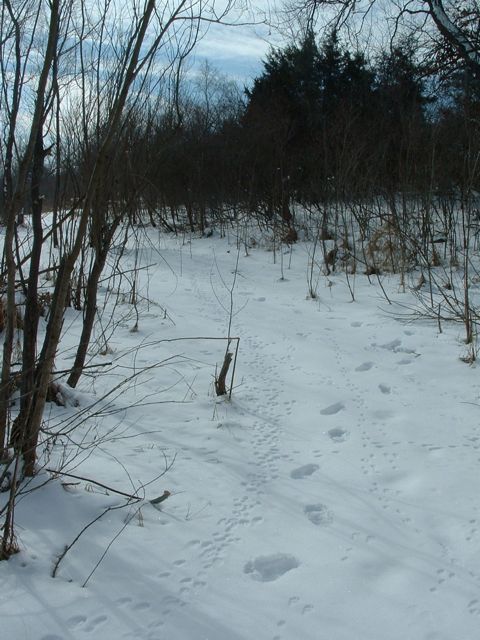

Just to the right of this photo's field of vision is the weir at the road culvert. Apparently, when it was built, the creek bed was perhaps fifteen feet lower, and what was at first a deep, cool swimming hole and wetlands eventually filled in with fallen down bluff and created the meandering creek we have now. With the outlet controlled by the wier, the creek through the farm will continue to look more U-shaped than V-shaped, except at the edges.
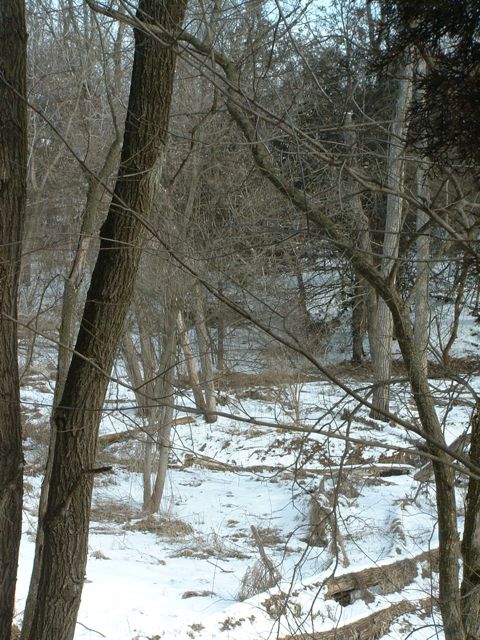
The gullies will require a different treatment than benign neglect, actual structures, terraces, impoundments, weirs, energy dissipation.


This is the bottom terrace in the observatory field, the big 11-ac field that comprises the southwest quarter of the farm. Like the other terraces, its drainage system failed some time ago, long enough that this willow colony has grown up and thrives on the periodic ponding.


With the drainage pipe failed, runoff ponds behind the terrace until it overtops, and erosion works back until there's not much earthwork left. We continue to cogitate about how to move big chunks of concrete – a raw material we have in ample supply on the property – to build erosion control structures. We're thinking of building a derrick or crane with a winch, powered by tractor hydraulics or pto or independently.


The pond rose dramatically in this thaw, to a level we'd not seen before but still well-below the outlet level of the primary spillway, a PVC pipe with an elbow joint into a corrugated metal pipe that passes through the dam embankment. The previous owners insisted to Alan and Donna that the pond had always been at the spillway level during their two years on the place.

You can see how much the ice sheet lifted, and how much larger the pond surface area became.


And then we noticed a sound of rushing water in the spillway pipe. The sound grew louder over the next couple days, and the pond level was dropping.


We had to conclude that the ice had damaged the outlet and we now had a big leak. 


There was nothing for it. The connection of PVC to CMP was rudimentary, ill-fitting, and the adhesives and clamps had crapped out. There was little choice but to pull it apart, and start to dewater the pond to the point where we could access the pipe and make repairs. After we pulled off the riser, water was free to gush down the CMP, and it made quite a flood at the outlet.


Here's the mysterious outlet works. Mysterious in that we can't figure out what the hell is going on here. There's a valve somewhere down there that we've not dared to turn. Below that is a crude well made of a tractor wheel rim plastered in concrete. It has an inlet, presumably from the valve, and an outlet through flexible plastic pipe.


But the well has rusted through and the outlet level is now below the drain pipe, so the water cut a channel instead. All the flow you see here is a result of the broken inlet up on the other side; we'd only ever seen seepage conditions here before.

So, all that set us a pretty good puzzle.


Sunday, March 31, 2013

Take a Morning Walk Through the Soundscape

Put on your headphones and spend the next 30 minutes walking a loop around the farm, through woods and across the creek and along the fences that border the meadows. Crunch through the last of the snow. Listen to birds of all sorts, sounds distant and near. Explore the soundscape through this audio verité field recording.

This is a rather quiet recording, so if there is very much noise in your listening environment, you'll hear the sounds of the farm much better if you wear headphones.


Morning Walk - 27 March 2013 by American Nacre

Thursday, March 28, 2013

An Expression of the Season

On February 28 and March 1 we had another substantial snowstorm, and afterward brilliant blue skies and calm winds and dazzling celestial displays in the night. I bundle up and take my walks, frequently stopped in my tracks by the impact of my surroundings: awe and joy at the perfection of form and texture, light and shadow, snatches of birdsong and the silences in between.

The east garden, its row of asparagus and the sweet potato mounds:


Squeaky Tree:


Lobster Tail Trail:


Toward the north fence line and the draws with coyote dens:


Big Bucket Trail:


The ancient hickories at Turkey Holler:


The Gorge:


The Grand Traverse:


Approaching Tire Shrine:


The Ford:


Hidden Meadow:


Across the top of the Trap Range:


Below the dam:


Rabbits congregate beneath this maple near the burn barrel:


The bridge-to-be, and across the dam, the pond and the terraced observatory field: