At the equinox, Alan was away so I set the sunrise marker on the observatory on my own. From the west side of the field I sighted east through the aluminum pole in the center of the field, to the eastern horizon as the sun appeared. Then I pounded this stake in the ground with a large hammer. It came out pretty close to the autumnal equinox stake from last September, as it should. We'll keep adjusting these points as time goes on, until we figure out what to use for permanent monuments around the perimeter of this 11-acre field.
As I did in September, after setting the stake I hurried down to our entrance at the county road, to watch another sunrise from below the top of the bluff and demonstrate how precisely east-west is the road alignment. It was so cold! About 10℉ and -5℉ windchill, painful to face and fingers.
And a few days later, another snowfall. For hours and hours, in barely-freezing temperatures. Perhaps for the last time this season, the farm was transformed into a winter dreamland.
This is the back end of the shooting range, the 80-yard rifle targets. You can see the platform in the background. The "chimes" are 1/2" plate steel and stainless steel.
A week ago the pond froze over in a genuinely hard freeze. The next morning it was 12℉ at 6:30 a.m. I took my walk in perfectly still air, and so dry that no frost had formed on the ground. Up by the meditation bench, an enormous branch from a big dead tree had fallen to shatter across the trail. There was no wind, so I wonder if moisture inside cracks froze and burst the wood fibers, splitting a third of the tree away from the trunk. Once I get to it, I reckon there will be enough firewood to fill the new wagon three times.
This poor ornamental maple is on a game trail where it crosses the lane and has been severely "buck rubbed" by male deer. They're marking territory, or maybe their growing antlers irritate them. I'll be surprised if the tree survives. The deer do a lot of damage and this is one of our greatest concerns as we prepare to plant the first acre of apple orchard. Everything we read and hear about control is consistent: keep dogs in the orchard fulltime with invisible fence, or erect 8-ft high barrier fence, or erect 5-strand electric fence. It's going to be a large challenge, and little wonder that for such difficulties almost all farmers have abandoned truck cropping for commodity grains.
The creek at the site of the ruined bridge had quite a bit of ice where the water tumbles over a small drop, and long reaches upstream of here were frozen over. That log has been working its way downstream and in its present position has been pushing the stream into the bank, causing erosion. As I crouched within the banks to record the sound of falling water, three deer appeared, silhouetted against the sky at the top of the woods, and I watched as they made their way north along the verge of the Hardwood Meadow.
Once the deer had gone by, I left my position and crept upstream along the creek trail behind them, eventually coming alongside and finally startling them, at which point they bounded away.
I came across this burl at the base of a young Osage orange (hedge apple) tree, which looks like it should be hollow or soft but is as dense wood as the rest of the tree.
This is the view to the west from Eye Chair, across the creek to the barn on the other side of the valley. The views have changed so much since summer, when down in the valley there was no indication at all of the farmstead. These are burr oaks, and behind them willows and cottonwoods, all starkly majestic, the woods at rest for the winter.
These are recordings I made that morning as I spotted and followed the deer. Distant grain dryers remain an omnipresent part of the soundscape, but these should fall quiet as the harvest is dried to a moisture content at which rot is no longer a concern. I look forward to experiencing, someday, the total absence of machine noise in my hearing, a pristine silence free of the artificial.
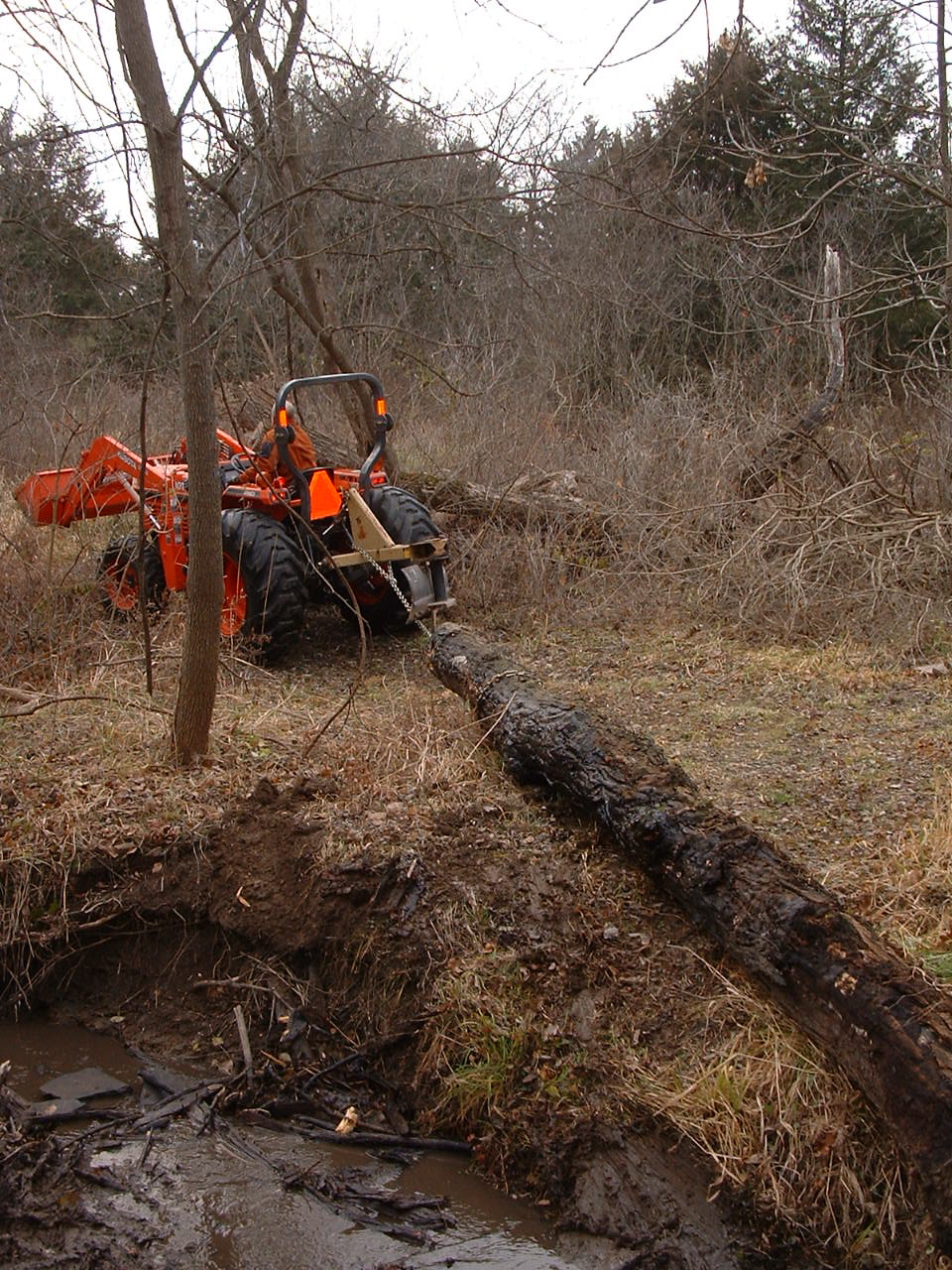
Sunday afternoon, after a day spent trimming trees and shelling beans, I suggested to Alan that, with an hour of so of sunlight remaining, we should get that big log out of the creek. He was game, so we pulled on our mud boots, loaded the tractor bucket with chainsaw, logging chain, gaff, and pry bar, and set about the task.
The log was so punky that it broke from the strain of pulling. We sawed it into lengths short enough that if a flood moves them downstream, they won't get hung up in the drop structure and box culvert that pass the creek beneath the road at the downstream end of the property.
We made a bucket-wide cut in the bank and used salvaged chunks of broken concrete to begin building a ford for low-water crossing, but quickly ran out of daylight, and completion will wait for another occasion.
Frank and Debbie visited recently and we kept them busy. One of the tasks was constructing and installing a 100-yard target at the range. Debbie is shown here taking some of the first shots at the new target with the .223 "varminter".
Another task was salvaging this culvert. Sometime before we arrived, it washed downstream in a flood from a former creek crossing. We found it standing upright in the bed, buried several feet in mud, and had been waiting for more helpers before attempting to move it. We shoveled enough mud to get it loose, then applied chain and tractor power in several configurations before freeing it and pulling it out.
The culvert isn't nearly large enough even to pass a two-year flood so our current thinking is that we'll use it for a low-flow crossing, weighted with chunks of concrete, and with stone approaches that will simply be overtopped during floods. Water is so dense that not only does it have great pushing power but also produces large buoyant forces, physics evidently not well understood by whoever previously installed this culvert, and also the ruined bridge farther downstream.
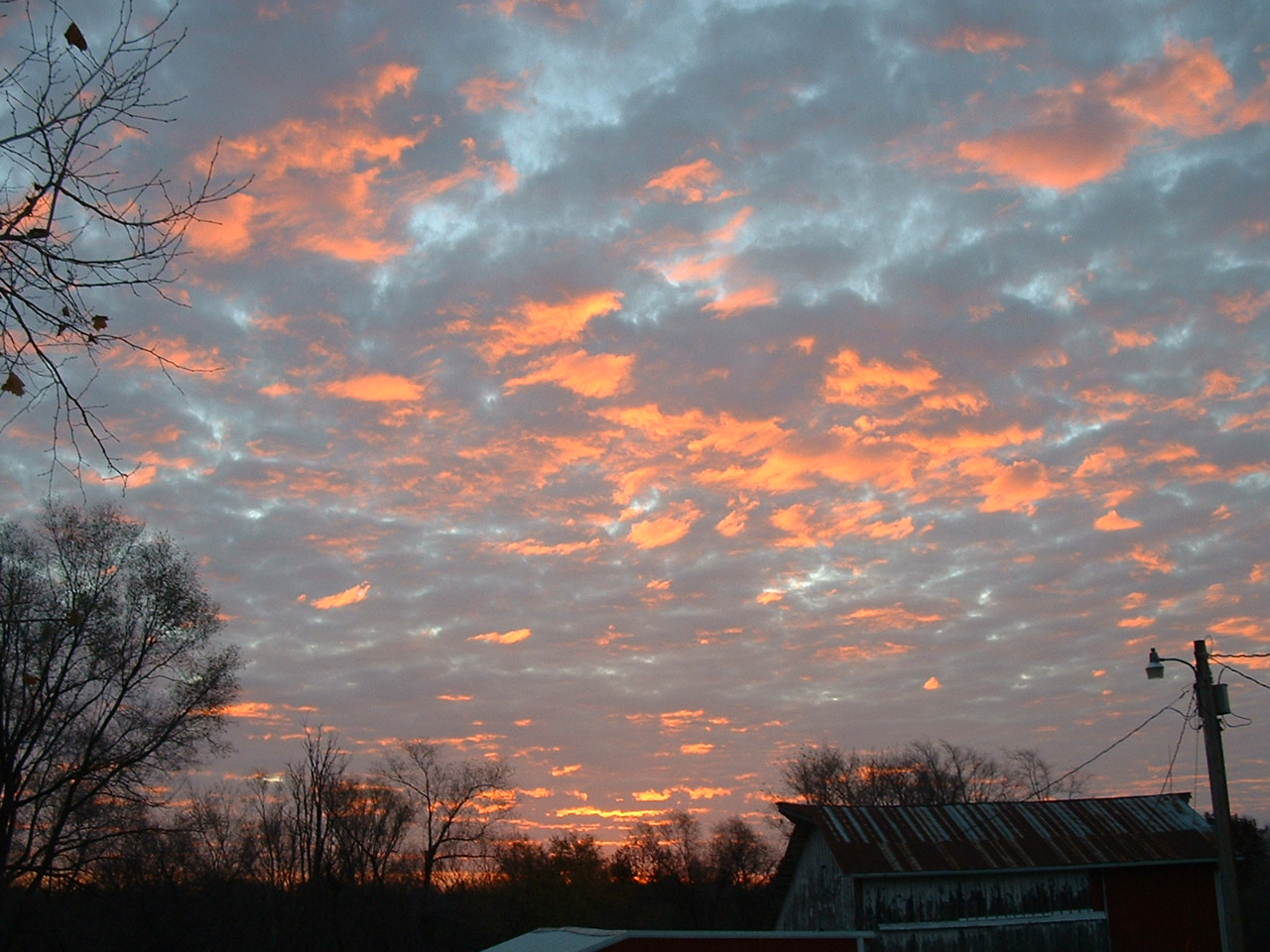
Halloween is another cross-quarter day (those that fall between the solstices and equinoxes) and we set another two points on the observatory at sunrise (which was rather spectacular) and sunset.
The northwest field will be the beginning of our cider apple orchard, and we decided to build several swales to capture and infiltrate runoff from that rounded hill before we install the trellises upon which we'll plant dwarf and semi-dwarf trees at a density of about 340 trees per acre (16-foot row spacing by 8-foot tree spacing). We have a new (used) piece of kit, this PTO-driven tiller, which did an admirable job breaking up the pasture turf. We then switched the tiller for the blade, moved the loose material downhill to make berms, and compacted the berms with the tractor wheels.
We have arranged with a "sharecropper" to hunt deer on the farm, as none of us have any experience; this takes us a step closer to resolving some of our qualms about killing animals if we intend to eat meat. If you click on the photo you can see the stand he erected on the verge of the woods. In recent weeks I've seen a four-point buck and several does, and a half of one or another will wind up in our freezer if the hunter is successful.
Beyond the front door, the barn, the woods, beyond the clouds and the sky itself, I am connected to it all and more – separation is an illusion. All matter, all life, is one. Uni-verse.
Alan and I have cut down all the trees on the dam embankment, an important maintenance task long deferred, and this has opened up new views into the Kincaid Creek valley. I imagine it as the land that time forgot, wild and left to the animals.
We're still working on our logging rig, so the felled trees remain on the slope, and these thick tangles have become the haunt of a new arrival, a cat that first showed up two or three weeks ago. It looks domestic and healthy, definitely not a tom, and how it got here – abandoned or run off or merely seeking its fortune – we've no idea. We can't get within 50 feet of it, but we've invited it to stick around and be a barn cat if it wishes.
In the Hidden Meadow, this dewy web.
Down by the road embankment, where the creeks passes over a drop structure and through a large culvert, is the ruined farm bridge, lifted and twisted by a flood.
I've now dismantled the wreck and salvaged the planks. Alan ran some hydraulic and hydrologic simulations as part of a redesign, and determined the new bridge should be elevated about 18 inches above the bank to pass a five-year return interval event. Our experience with the shooting platform makes us confident we can construct the superstructure and deck, but the approaches will be a little trickier. If we make them of compacted earth they'll be subject to erosion in a flood, while steel or lumber will be subject to floatation and impact by water-borne debris. But that's just the sort of problem-solving we enjoy, so we'll figure out something.
In the backyard, a windstorm knocked over a third of this tree and left it dangling perilously, but as our friend Gary says, "What problem? You've got a tractor." So down it came, and then the chainsaw, and now it's a pile of logs near the fire pit.
Behind the tree is the Mystery Building, possibly a chicken coop at one time but now 90% remodeled as habitable space. Alan and Donna installed light fixtures some months ago, and about ten days ago got baseboard heaters installed. The floor is a pretty good concrete slab but it has a large crack from uneven settlement, so the next big job is leveling and covering. It would make a good studio, or bunkhouse but its ultimate function remains...a mystery.
My morning constitutionals yield often-amazing sights, and there's really nothing more I can add to that. (Don't forget that you can click the photos for larger images and a more slideshow-like presentation.)