Ruminations as we develop and manage a small farm in southeast Iowa. Click photos for larger images. Click here for farm map.

Thursday, August 23, 2012

Catching Up

The drought broke here, after a fashion, on August 4 when during a large outdoor party in the afternoon we got a terrific thunderstorm and blow that dropped 1.5" of rain. Two hours later, though, one would never have known it had rained – there was no runoff nor even puddles. Since then we've had a couple storms that left about 0.7" each, and a couple at 0.1". None of this has restored the deficit and there's been no runoff so the pond continues to dry up and in the surrounding countryside the corn continues to die. Still, the grass has greened-up and everything looks a lot better. Temperatures moderated over the past couple weeks, 80s and 90s, and this makes for easier working outdoors.

In Seattleland, I always had the impression of the sky, and weather, being quite close to the ground. The skies here in Iowa are big, expansive, and layered into the stratosphere. On several recent days the cloud cover has primarily been composed of condensation trails from aircraft crisscrossing this piece of flyover country.


Today I met the farmer on the other side of this fence. He'd was looking for a four-year-old, 2500 pound bull that had gone missing, and I had to tell him I'd not seen it. It's a bit of a mystery because his pastures are well-fenced, but he told me that, without the addition of electric wire, a bull of that size can jump five strands of barbed wire. I rather hope I don't find the big thing.


The previous owners installed chain-link fencing around the house, presumably to contain their small children, and one of the first things Alan & Donna did when they arrived was to take down the mesh, but the posts were set in concrete – not just the corners but every one! – and proved quite difficult to remove. Alan and I gave it another go last weekend, using a technique derived from a 1909 book, Handy Farm Devices and How to Make Them. We had a tractor instead of a team of horses, but the principles were the same. Our first attempts failed, but after digging away the turf that had covered the top of the concrete bases, creating little moats, and soaking these for a while – success!


Now the collection of posts is stacked in our stockpiles area, awaiting repurposing. Perhaps we'll cut off the pipes above the concrete and make giant wind chimes in the woods.

On a recent evening the clouds boiled up then, as has usually been the case, parted and went around without producing rain. But such magnificent tableaux! As my hero Jack Vance might put it, allegories of battles between good and evil...


The rain caused a lot of the tomato crop to split on the vine, and these fruits require a lot of culling and trimming before we can use them, but the dehydration project continues and the next step will be to pack them in oil and herbs. There are still a lot more on the vines, and sauce to be made and preserved.


Donna harvested Concords from one of the grapevines and made jelly. A rip-roaring success for her first attempt at this – excellent color, consistency, and flavor.


Wednesday, August 8, 2012

Atlas and Diary

Opening up the trails has given us more and easier ways to get to the east side of the property, and from the verge of the woods and eastern fields I watched the sunrise a few days ago.


Moving the gaze south one encounters the neighbor's massive oaks.


First rays catching the interior of the cedar forest.


This sequence approaches the ruined bridge near the grade control structure under the county road.


It floated in a flood and turned sideways and was destroyed. We think we can salvage much of the material to build the replacement bridge. It's going to be a good challenge to build something that we can take the tractor across and that will withstand flooding.


Looking back the other way.


Of course, the full moon always sets opposite the rising sun, so by the time I got back out of the woods on the west side...


And here some spatterlight in the grandmother cottonwood tree.


Saturday midday a rather violent thunderstorm blew through, leaving an inch and a half in the gauges after about 40 minutes. There were no puddles, no runoff, and three hours later no indication that rain had fallen except that everything was a lot cleaner with the dust rinsed away. We could use a rain like that every day for a week, so it's no end to the drought. But the rain we did get and the moderate temperatures behind its cool front have made everything look and feel better. It's been cool enough to really enjoy the pond and Deck Dock.


Monday, July 30, 2012

Maiden Voyage

If it looks like we're having fun around here it's because we are.  Don't get me wrong there has been plenty of hard work along the way and I have the bum shoulders to prove it.  Sometimes though we really let our hair down.
This was the first time Alan has been able to use his dad's old Evinrude Lightwin motor since it was tuned up a few years ago.  My brother, David, has graciously given us his old beloved BassTender.  It is a tiny little thing that is only rated to up to 6 hp and hasn't seen water in a long while.  The Ace hose cap seemed to work and there was just a 1/2 cup of water in the stern when we finished playing around for the evening.


Alan said he thought we'd reached a new "white trash" limit but that was before we actually got the vessel out on the pond.  I think it is pretty awesome and the "necks" would think it much to sophisticated.  We keep talking about putting a motor mount on the dock.  Now that would be "White Trash" but damn it'd be funny.  Don't worry we'll take video.

Sunday, July 29, 2012

Rainbow at Dawn

We set a live-capture trap for whatever it is that's scaling the fence and eating the sweet corn, using cat food for bait on the assumption that we're dealing with raccoons. Temperatures cooled enough overnight that about four o'clock this morning I turned off the air conditioning and opened the windows and listened to the breeze in the sycamore, the bullfrogs in the pond, and a few errant drops of rain upon the roof. By five-thirty I'd had enough bed time and got up to find that the trap hadn't caught anything, but neither were there any freshly-molested corn stalks.

Just at sunrise this was the view to the east.


And to the west, a symbol of hope. A little later a nice shower fell but I don't think it amounted even to a tenth of an inch.


We're finalizing preparations for a to-do that commences in a few days, the Palmer Long Outdoor Weekend, Muscatine Edition. The working-out of the acronym is left as an exercise for the reader.

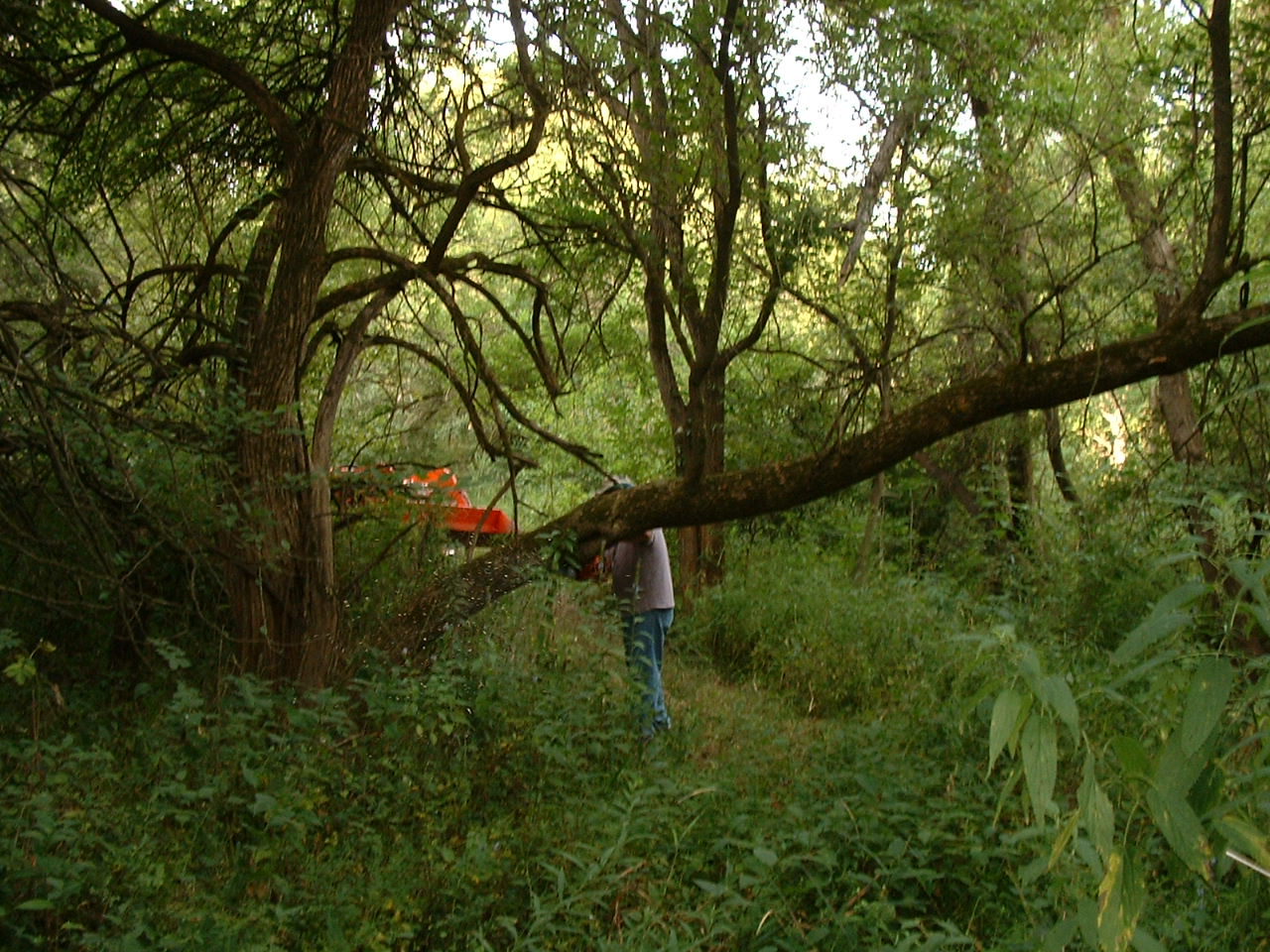
We're keen to get the trails in good shape, so Alan and I were out with the chainsaw and rotary brush mower, pushing through the spots where fallen trees obstructed the old tractor trails that we're re-establishing, and finishing the surfaces.


Eye Chair exposed! It had been buried beneath a fallen, over-mature black cherry.


That black cherry is now a stack of logs. We're looking into ways we might market the wood, possibly as stock for lathe turners, lumber for furniture or flooring, or gunstock blanks.


Here a trail branches into a loop through Cedar Grove. Counting the field perimeters I think we've got about three miles of trail at this point, with a wonderful variety of vantages, up and down hills, along the creek, past the old growth giants.


And we've essentially completed the shooting platform at the trap range. It is a very sturdy construction!


We've got some other features in store for our guests this weekend, and those that follow. But that is all for today!

Friday, July 27, 2012

Drought and Despite

Temperatures have moderated a little the past couple days – 80s and 90s, but the drought is relentless and there is no rain in the forecast. The survival of plant life depends on the amount of water in the soil column that can be extracted in the root zone, and evapotranspirative demand by the plant. The following chart indicates ET at several stations in the state, calculated with Penman's equation and using a crop coefficient of 1, simulating conditions for well-watered turf. The coefficient and thus ET becomes lower with exposed soil and with water in the root zone at less than field capacity (the amount of water the soil will hold just before it begins to drain).

The chart shows an ET value of 0.28 inches at the Muscatine station yesterday, in line with what have been daily values of 0.25-0.33 inches for the past several weeks. Depending on soil composition (relative proportions of sand, silt, clay, humus) and structure (for instance, the size, shape, and number of voids), a foot of soil might hold 1-4 inches of water at field capacity. Depending on the crop, the root zone might be 1-4 feet. The issue with drought in rainfall-dependent areas becomes obvious.


A corn crop requires about 32 inches of water for maximum yield, which is almost exactly the annual rainfall across Iowa. So far this year, we've received only a third of the rainfall expected as a long-term average. It's a tenuous situation.

The Sonoran Desert of Arizona gets less than 2 inches of rain per year, yet this is where most of your iceberg lettuce comes from, thanks to canals and pipelines that deliver enormous volumes of water from river systems hundreds of miles away. Each of the several crops per year of lettuce use about 12 inches of water. A lot of alfalfa is grown there, too, for hay and silage animal feed, mostly beef, and it demands 60 inches a year over four or more cuttings. One begins to appreciate, perhaps, the true costs of delivering a Big Mac to the blithe customer at a seemingly bargain price.

Two nights ago we had a nice shower of rain but the gauges captured only 0.2 inches. It infiltrated less than an inch into the soil. We've become reluctant to irrigate the gardens because we know nothing about the depth, yield, drawdown curve, etc. of our well, the only source we can deliver to the gardens at present (the rain barrels captured only about 30 gallons from the shower), and our sole source of household water.

The pond, with no inflow the past couple months, is drying up at that same relentless pace of a quarter to a third of an inch every day.


The garden is stressed. The sweet corn and popcorn have some leaf curl but seems to be slowly filling the ears. But some critters larger than rabbits, probably raccoons, are scaling the fence now, breaking down the stalks and leaving half-eaten ears on the ground. I see electric fencing in our future.


A few individual fruits in the Concord grape clusters are beginning to show some purple. These are old vines with a well-established root structure, so we'll probably have a harvest and then another method of preservation to learn – jelly!


The cucurbits (the plant family that includes squashes, melons, and cucumbers) wilt alarmingly in the heat of the day but recover again in the evening, and so far are bearing prolifically. The winter squash are filling, and the melon are ready to eat and are delicious. Today I cleared the cucumber vines of all the overripe fruit. They're still blossoming profusely and now we can try again to harvest them while they're still pickle-sized. Our attempts at pickling the first batch of overripe fruit have been a mixed bag as the skins of some were just too bitter for the vinegar, sugar, and spices to overcome.


The tomatoes are really coming on now from both the transplants and the volunteers, several varieties of shape, color, texture, and flavor, and they taste great. So far our preservation method is dehydration. This image show the loaded dehydrator, the rest of today's harvest, dried fruit from a few days ago, and melons.


The mustards have bolted but for the time being the leaves remain a good source of salad greens. They, and the turnip greens, are also good cooked. I've got kale transplants ready to put in the ground if and when the weather turns, and they should then last into the first frosts. Once it cools down we can plant some more lettuce.

This is my nemesis, purslane, and at last I seem to have gotten ahead of it, but it ruined an area of the garden where I'd planted herbs and stole a lot of water from the vegetables. It was blossoming and had it gone to seed the situation would have been even worse next year. It's an edible, small-leaved succulent with a tangy flavor, more commonly used in Europe than here. It's good in salads, but after hoeing and pulling great mounds of it only to find more after a couple days, I've little appetite for it.


The infestations come one upon another, noxious weeds and insects and invasive plants: thistle, poison ivy, Japanese beetle, honeysuckle. The latest is Queen Anne's Lace or wild carrot. Eradication is a long-term project and yearly control laborious. In this weather I've only been able to work outdoors for an hour or two at a time, and some things just don't get done.